
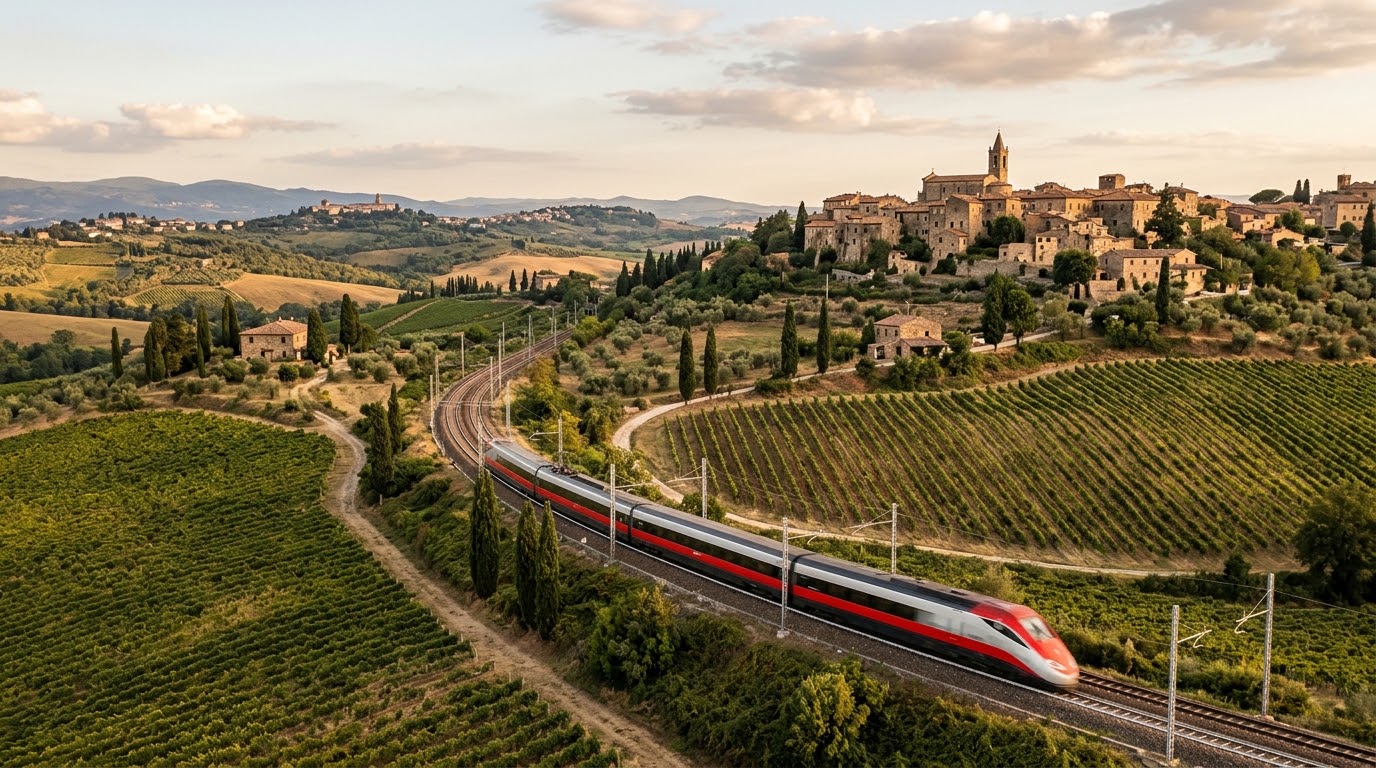
Italian rail routes include different train categories and operators, with different booking and travel conditions. A city may have several stations, and the most convenient one is the one that serves your actual route.
Compare the whole journey
Check the station, travel time, frequency and any changes required. Verify ticket validity, reservation requirements and any steps required before boarding. Consider the distance between the arrival station and your accommodation.
Keep independent connections realistic
If a regional train is part of a longer itinerary, allow time to navigate the next station and account for disruption. Check current service information and baggage rules before departure. A faster train can be useful when it preserves meaningful time at the destination; a regional journey can work well when flexibility and intermediate stops matter more.
Compare regional and long-distance services on the same route
For a relatively short journey between neighboring towns, a regional train may offer a convenient direct connection. On a longer intercity route, a reserved high-speed or other long-distance service may save time. Do not compare only the minutes spent on board. Look at the frequency, station locations, transfer requirements, ticket restrictions and time needed to reach the platform. The station closest to a city center is not necessarily the one served by the train you are considering.
Use the current timetable from Trenitalia, Italo or the relevant regional operator. Read the conditions for the particular ticket, including any validation, check-in or reservation requirements. Digital and paper tickets may have different rules, and these can change. Do not rely on a general statement that all regional tickets work the same way. Check whether the fare covers every segment if a trip involves more than one operator.
Make a simple day trip resilient
For a visit to a smaller town, locate the station relative to the historic center and find out whether the walk is suitable for your companions. A return train with a flexible ticket may be more useful than a cheap restricted fare if you do not know how long the visit will take. On a day with a museum reservation or onward flight, leave an appropriate margin and identify an alternative service. Keep travel documents accessible and watch the official departure information for platform changes. Choose the train category that solves the actual journey rather than selecting one type for every trip.
Images are generated editorial illustrations. Confirm current access, schedules and conditions before traveling.